
Maxwell's Silver Hammer
The mathematical system unique to relativity is nothing more than another form of the trick born from a simple oversight. In this chapter, we examine the trick of the “multiply‑by‑one function,” a device that has influenced relativity from its very birth to its later development.
Depending on how it is used, this function can generate any trick imaginable—from producing reset‑style equations to deriving entirely fictitious relations. Yet the moment when this all‑purpose function shows its greatest power is neither when it is used nor when it is forgotten, as Einstein did.
Its true impact comes when people finally realize that they have forgotten it for a full century.
And that moment will be on full display in the collapse of relativity that is about to unfold in the real world.
“In this book, the speed of light is written as ‘C’ in classical physics and as ‘c’ in relativity. This notation is used simply to clarify which version of the speed of light is being discussed.”
- 4. Maxwell’s Silver Hammer
- 4. 1. What Is a Function?
- 4. 2. The “Unknown” Function That Isn’t Unknown
- 4. 3. Restricted Possibilities
- 4. 4. The Function That Does Nothing—and Deceives the World
- 4. 5. The Omitted Function
- 4. 6. Recognize the Omitted Function
- 4. 7. Can Your Wallet Reveal the World’s Exchange Rates?
- 4. 8. Do the Laws of Motion Change with the Ratio of Speeds?

4.1. What Is a Function?
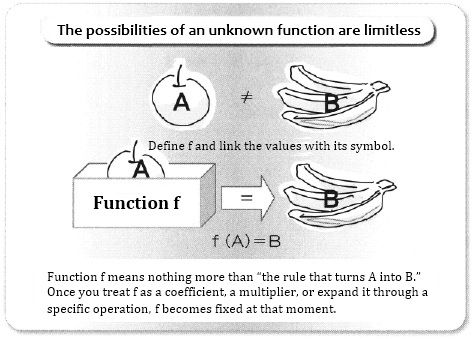
In mathematics, a function is treated as a set of operations that converts one number into another. For example, suppose a function F mediates the conversion from a number A to a number B. In equation form, this is written as
F ( A ) = B.
The number inside the parentheses is the input, and the function F represents the operation that converts A into B. Let us look at the cases where A = 1 and A = 2.
F ( 1 ) = 2
This means that the number 1 has been converted into 2 by the function F. Since F is an operation, we can infer what F might be by thinking of a calculation that turns 1 into 2.
A simple guess would be something like:
F ( x ) = x + 1,
an operation that adds 1 to its input.
Another possibility is F(x) = 2x, an operation that doubles its input.
These two are merely examples among many possibilities. There are many other functions that perform the same role.
Next, let us consider the case where the function takes two or more numbers as input.
F ( A, B ) = C
Here, the function F converts the numbers A and B into a number C. If A, B, and C are 2, 2, and 4 respectively, then
F ( 2 , 2 ) = 4 .
And we can again guess that the function is something simple.
However, many different functions could fit this:
F(A, B) = A + B
(a function that simply adds A and B),
or
F ( A , B ) = A × B
(a function that multiplies them), and so on.
A key feature of functions is that the numbers inside the parentheses are not restricted to being ‘quantities used in the calculation’; they may also serve as parameters or tools.
It might even be something like
F ( A , B ) = A² × ( B − 1 ) .
In more specialized cases, F might be defined by a dedicated lookup table— meaning “refer to the value in column A and row B.”
Thus, even though we casually call all of these ‘functions,’ their nature and behavior vary widely. A function has the convenient property that, as long as its name appears at the front of an expression, it can represent virtually any operation. But this very convenience can itself become a source of mistakes, so one must be careful.
4.2. The “Unknown” Function That Isn’t Unknown
To determine the exact nature of a function, we must consider not only the final result but also the intermediate steps.
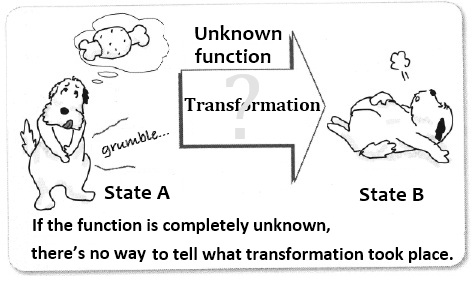
In physics, simply stating that “a system moves from state A to state B” is not enough to determine how that transition occurs.
If the transition process cannot be predicted at all, we must treat the function F as a completely unknown function and proceed with caution. This is because, as we saw earlier, infinitely many functions can satisfy a single equation.
In physics, both the final answer and the intermediate process must be consistent and correct. When attempting to solve a physical equation that no one has ever resolved, the function at the initial stage must be treated as entirely unknown.
Even if numbers or symbols appear inside the function’s parentheses, how they should be processed cannot be determined without experimental data or reference to past equations.
Einstein’s original relativity paper claims that adopting the principle of the invariance of light speed into classical physics forces the rejection of simultaneity.
Events that appear simultaneous in one frame are said to be non‑simultaneous in another. (This, too, is actually a misunderstanding caused by an oversight, as explained in Chapter 6.)
If one denies simultaneity and then applies that idea to the Galilean transformation—which worked perfectly well in classical physics—contradictions naturally arise. To make the equations hold, Einstein introduced a previously unknown function τ.
He then placed the spatial coordinates x, y, z and the time coordinate t inside the parentheses of τ. Since our focus here is the structure and expansion of the equation, we simplify by replacing the coordinate values with A, B, and C.
1 / 2 [ τ ( A ) + τ ( B ) ] = τ ( C ) …… (Equation 4‑1)
In this equation, the unknown function τ has an unknown role regarding whatever appears inside its parentheses.Therefore, τ(A), τ(B), and τ(C) must be treated as completely independent functions whose relationships are entirely unknown.
Anyone who understands the nature of functions would notice the differing inputs and avoid expanding the equation carelessly. Normally, without data about the transformation process, the derivation should stall at this point.
Yet relativity proceeds with its derivation even in the complete absence of experimental or physical information. This occurred because Einstein wrote all instances of τ using the same symbol, leading him to treat an unknown function as if it were merely a coefficient.
He did not “solve” the function—he simply restricted τ to behave like a coefficient and expanded the equation under that assumption.
Here, a coefficient means something that merely multiplies the contents of the parentheses by τ. By combining the contents of the parentheses, he ends up deriving a form for τ. The derivation appears mathematically valid, but it completely ignores the premise that τ is an unknown function.
It also ends up directly combining data from different coordinate systems.
A crucial difference between relativity and classical physics is that, in relativity, data from different frames cannot be combined unless they are transformed using relativity’s own relations. Because the flow of time differs between stationary and moving observers, transformations between frames require special handling. Equation (4‑1) attempts to assign that transformation to the unknown function τ.
But treating all τ symbols as identical and combining the parentheses as if they shared a common basis effectively assumes that all frames use the same fundamental units.In other words, the function τ becomes unnecessary.
Treating τ as a coefficient is only possible if one implicitly relies on classical coordinate transformations—and at this stage, relativity has already collapsed.
4.3. Restricted Possibilities
When a function is defined as unknown, its possible operations and behaviors should be kept as broad as possible. For example, suppose we define an unknown function f, and
f ( x , y , z , t )
appears as part of an equation.
If the result of processing the data inside the parentheses with f turns out to be
1,
you would naturally wonder how x, y, z, and t were handled.
If we truly understand the possibilities of an unknown function, then “doing nothing and returning 1” must be considered one of the strong candidates.
Just because data appear inside the parentheses does not mean they must all be used in the operation. In Equation (4‑1), the assumption that every parameter inside τ’s parentheses must be used in the transformation unnecessarily restricts the possibilities of an unknown function.
Such thinking is important when dealing with coefficients, but for an unknown function it eliminates many valid possibilities.
Even if x, y, z, and t all appear inside the parentheses, the function may act on only one of them.
For example, since τ was introduced to address the loss of simultaneity, it could act only on the time component t, as in
τ ( x, y , z , t ) = [ x , y , z , f ( t ) ] .
This reflects the idea that the spatial components serve as data for the transformation, not as quantities to be transformed.
Einstein’s treatment directly contradicts this principle.
When expanding an unknown function, unless one keeps such forms in mind, the spatial components x, y, z will be absorbed into a function intended only to modify time—resulting in the unintended modification of space as well.
Since the contents of the parentheses are merely data, each symbol in the equation must be examined to determine which elements the function should act on in order to maintain consistency.
In Einstein’s equation, the time component t is expressed as a distance
L / speed S .
Applying the function to either the distance or the speed alone would yield a much simpler relation for τ.
The paper overlooks the coordinate transformation of the distance L when the observer is moving. Because the assumptions are switched conveniently just before contradictions appear, applying the function to either quantity can be interpreted as both wrong and right.
Unless one fully understands the structure of the paper and its multiple oversights, stating the “correct” choice here would only create further misunderstandings. For that reason, I will refrain from giving a definitive answer at this point.

4.4. The Function That Does Nothing—
and Deceives the World
There are cases where a function is defined, yet the output does not change at all. In expressions like F(x) = x, the function F either performs no transformation or is simply a
“multiply‑by‑one function.”
A multiply‑by‑one function outputs the input exactly as it is. Thus, writing it explicitly usually only clutters the equation and seems to offer little benefit.
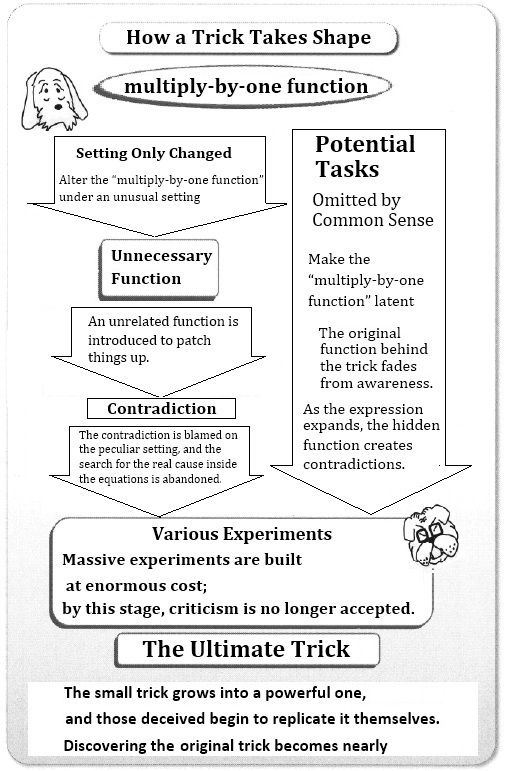
In practice, you will almost never see this function written out in an equation. Since it does not alter the value, it is routinely omitted in practical formulas. Once omitted, people stop being aware of its existence altogether.
Yet in relativity, this easily overlooked function becomes an essential component of the trick.
If one wished to construct a physics trick capable of deceiving the entire world, this routinely omitted function would be the perfect tool. Used skillfully,
the trick itself disappears through omission—and no one notices.
To uncover problems caused by such tricks, one needs knowledge of functional sleight‑of‑hand and a calm analysis free from preconceptions. When encountering an unfamiliar setup, the key is how well one can recognize the omitted function lurking beneath the surface.
4.5. The Omitted Function

Einstein, who had been something of an academic underachiever, seems to have been rather careless in his treatment of functions. In particular, his handling of unknown functions contains numerous obvious errors.
But we cannot place all the blame on Einstein alone. The scholars who supported his theory had plenty of opportunities to point this out—so why didn’t they?
Most likely because the assumptions Einstein imposed were so unconventional that no one had ever analyzed such a setup before. Let us examine, through a simple example, how easily people can make mistakes when dealing with a situation humanity has never encountered.
Suppose Galileo and Einstein are here, trying to calculate the total amount of money they have.
Let G be Galileo’s money, E be Einstein’s money, and M be the total.
Galileo writes the equation:
G + E = M …… (Equation 4‑2)
A simple elementary‑school problem—nothing unusual.
If G = 100 and E = 100, then
M = 100 + 100 = 200.
Simple enough.
But then they discover that Galileo has 100 dollars, while Einstein has 100 yen.
“Professor Galileo, Equation (4‑2) is missing the function that converts dollars into yen. Let’s call that function y and fix it.”
y ( G ) + E = M …… (Equation 4‑3)
Since Galileo’s money is in dollars, it must be converted to yen before adding Einstein’s amount.
But another issue arises: the total must be expressed in marks.
“No problem. We’ll introduce a function m that converts yen into marks.”
m ( y ( G ) ) + m ( E ) = M …… (Equation 4‑4)
With this, the value that appears in M should now be the amount converted into marks.
“See? With functions, fixing the equation is easy. We can even modify your formula to handle any currency.”
“True enough. But must we define a new function every time the conditions change?”
“Of course not. We can define a universal function f that converts all currencies into a common unit.”
f ( G ) + f ( E ) = M …… (Equation 4‑5)
“Einstein, if the entire world had only one currency, wouldn’t the function f be unnecessary?”
“Yes. In that case, f becomes merely a multiply‑by‑one function and can be omitted—reducing the equation to your original one.”
“Exactly. Which means my equation was already the ultimate form, requiring no further modification.”
“That’s unfair, professor. Your equation only worked under the special condition that there was just one currency—that’s why I fixed it.”
“Hmm…”
Galileo folds his arms and looks down silently. It almost seems as though the great elder Galileo is the one who made the mistake.
4.6. Recognize the Omitted Function
Einstein continues.
“There are many countries in the world, each with its own currency. If we cling to old assumptions, we can’t keep up internationally. Updating your equation is simply what the times demand.”
“I see. I understand now.”
“You do?”
“Yes. I finally understand why you created your equation.”
“Created? No, no—revised. I revised it.”
After a pause, Galileo asks:
“Every time a new condition appears, you define a new function. Is that really how you always proceed?”
“Yes. That’s how it works.”
“That’s the opposite!”
“Opposite of what?”
“Your entire way of thinking. My equation omits what is already obvious. It is a minimal form. If G and E share the same unit, we use them as they are. If not, we assume that the necessary conversion functions are already embedded within G, E, and M. That is the fundamental premise.”
He continues.
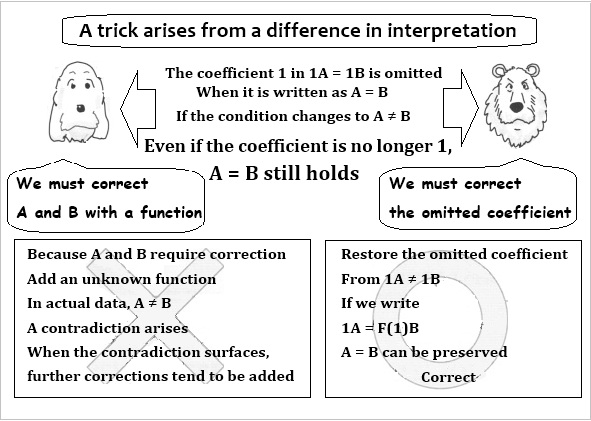
“What is omitted is the function that simply multiplies by one. If conditions change and that omitted function can no longer remain omitted, then we bring it back into the equation. Then—and only then—we modify that function to meet the new conditions.”
“But… isn’t that basically the same as what I did?”
“Think carefully. Finding the omitted function and modifying it is entirely different from inventing a new function and attaching it. If you fail to notice the omitted function inside G, you will—like you did—wrap the entire G inside a new function. If G contains only one function, fine. But what if it contains functions that should not be modified?”
“Then I’d end up modifying things that shouldn’t be touched.”
“Exactly. And more than that. Inside the conversion between symbols, the intended function remains a multiply‑by‑one function.
But outside that context, it has been modified and now behaves differently. This creates a dual structure—one number carrying two meanings—which leads to mathematical contradiction.”
“To avoid such disasters, one must recognize that my equation is a condensed form, and that the multiply‑by‑one function is, of course, omitted.”
“When I said ‘opposite,’ I meant this: You treat my equation as something that still needs more functions added. In reality, the equation already contains the function that must be modified—it is merely omitted because it is not needed yet. It is, in fact, an equation whose
“corrections are already complete.”
“If you wish to revise the equation, simply bring back the omitted function and modify that. Nothing more. If you fail to grasp this and keep adding new functions carelessly, you may end up creating an outrageous theory. Be careful.”
“…………”
“Don’t tell me… you’ve already done it. Unbelievable.”
“I called it the theory of relativity.”
“The name is irrelevant. What happened to my Galilean transformation?”
“I… use it as an approximation. But no one has noticed that my theory arose from placing a function in the wrong location.”
“You fool!”
4.7. Can Your Wallet Reveal
the World’s Exchange Rates?
A function that can be omitted is the “multiply‑by‑one function.”
For example, in an expression like a
F ( x ) = x ,
the quantity appears unchanged before and after the function is applied.
When numerical quantities can be used directly in calculations, the basic identity 1 = 1 must hold between their units. If the units are the same, the conversion function can be omitted; if the units differ, a conversion is unavoidable.
Galileo’s point is that even a function omitted under the assumption of identical units must be reinstated once differing units are suspected, and then modified as a conversion function.
Let us examine this more closely.
Let the conversion function from dollars to yen be
y ( 1 ) = 100 ,
meaning 1 dollar = 100 yen.
If Galileo has G = 100 dollars, that converts to 10,000 yen. Thus G contains both the number 100 and the unit “dollar.”
If only the number 100 is written, the omitted element is the unit “dollar.”
This hides the assumption:
“If the unit is dollars, the value is the same—just compare the numbers.”
In reality, even “dollars” differ in value between countries, requiring conversion. Normally we distinguish them by name, but here we intentionally treat them as identically named for the sake of the example.
Assume a special situation where two different “1‑dollar” units share the same name.
Suppose country I has 1 dollar = 100 yen, and country J has 1 dollar = 10 yen. Galileo has 50 dollars (type i) and 500 dollars (type j), and after converting j‑dollars into i‑dollars, the total becomes 100 i‑dollars.
G = 50 × 1 + 500 × 0.1 = 100 dollars (type i)
Thus G implicitly contains the conversion function from j‑dollars to i‑dollars.
Galileo claims he has 10,000 yen worth of dollars, but Einstein, looking only at the cash, concludes: “It must be 55,000 yen.” His reasoning:
50 + 500 = 550 dollars
y(550) = 55,000 yen
He overlooked the hidden conversion inside G and added the numbers directly. After completing the calculation without noticing this mistake, Einstein begins to wonder why the result is contradictory.
“Why is there a discrepancy between 55,000 yen and the actual value of 10,000 yen? Perhaps the exchange rate is fluctuating. I’ll define a correction function z to fix this.”
z(y(550)) = 10,000
z(x) = x / 5.5
“So z divides the input by 5.5. It’s fluctuating again.”
Seeing Einstein struggle, Galileo speaks.
“You still don’t understand. Change the conditions and try again.”
This time they recalculate with 10 i‑dollars and 5 j‑dollars.
In reality:
G = 10 × 1 + 5 × 0.1 = 10.5 dollars; y(10.5) = 1,050 yen
But Einstein computes:
y(10 + 5) = 1,500 yen
so the correction becomes:
z(1,500 yen ) = 1,050 yen
z(x) = x × 0.7
“Amazing! The exchange rate is fluctuating again.”
“Einstein, have you forgotten that there are different kinds of dollars with different conversion values?”
“Ah, I see. Your money seems to come in different types, so I predict that the function z fluctuates according to the ratio of the two types. We could determine this fluctuation ratio by solving the equations, though it might get a bit complicated. This is getting interesting.”
“It is not interesting. Your bad habit is rushing ahead before solving the first problem. The rate ‘fluctuates’ only because you attached your correction function outside G. All you needed was to find the omitted function inside G and modify that.”
“……”
“And really—my wallet cannot possibly change the world’s exchange rates.”
“Well… that’s true.”
The numbers inside G were assumed to share the same unit, so the conversion function was omitted. But once 1 dollar ≠ 1 dollar is discovered, the omitted function must be reinstated.
This unit‑alignment must occur inside G, without affecting anything outside it. Otherwise, conversions between different dollars are skipped, treating unequal numbers as equal—resetting the mathematical system.
If G is wrapped in a function wholesale, the numbers that should not be modified and the numbers that should be converted end up being replaced by their average as the target of the transformation. This is why Einstein mistakenly believed the function fluctuated according to the ratio of the data.
4.8. Do the Laws of Motion Change with the Ratio of Speeds?
Let us now return to relativity.
Einstein’s theory claims that space varies according to the ratio between velocity v and the speed of light c. But in classical physics—the very foundation of relativity—no such behavior exists.
This effect was not intended from the start; it emerged during the construction of the theory. In other words, it arose naturally as the equations were expanded.
The reason unrelated elements slipped into the relations is that Einstein introduced new functions outside the symbols instead of uncovering the functions already hidden within them.
Specifically, when assuming the invariance of light speed, he failed to notice that the Galilean‑transformed symbols c and v already contained omitted functions, and so he introduced an unnecessary new function at the front of the equation.
We normally use c and v without thinking because both rest on the same fundamental unit of speed. For example, 300,000 km/s and 100 km/s both rely on the same base unit, 1 km/s.
This shared base unit allows us to compute with c and v without worrying about their underlying definitions.
However, Einstein’s theory demands a situation where even the fundamental unit itself varies. The omitted equivalence
1 km/s = 1 km/s
is rejected the moment the observer begins to move, forcing a revision.
This was a type of correction no one had ever encountered. It implies a bizarre situation where the ratio 10 km/s : 100 km/s can no longer be expressed simply as 10 : 100.
In classical physics, the identity
v / v = c / c
1 = 1
always holds. If this identity held in relativistic frames, relativity would be unnecessary and none of its so‑called “relativistic effects” would arise.
Einstein kept c and v unchanged and, through a reversed process of modifying classical physics to build relativity, inserted c − v and c + v directly into the equations.
As a result, the new corrective function τ was placed not where it belonged but wrapped around the entire equation.
Because the equation contained time and length coordinates, this produced spacetime relations that vary with c − v and c + v—that is, with the ratio between c and v.
Thus, a principle that could have been expressed merely by canceling the Galilean transformation somehow evolved into a grand theory of spacetime. Hidden beneath this evolution is an astonishing fact: Einstein failed to identify the function that needed correction, inserted an unknown function at the front of the equation, and then expanded it as if it were a coefficient.
