The Attempt to Formalize the Principles
Has Already Failed
Trying to merge the principle of relativity, which has already failed in its formalization, with a completely unnecessary principle of invariant light speed c—two mutually conflicting principles—into a single theory can hardly have been an ordinary task. The reason relativity is said to be too difficult for ordinary people is that this work requires advanced mathematical expertise. Yet both the principle of relativity and the principle that the light speed c is invariant are, in themselves, simple and straightforward. Conversely, the idea that you can turn even contradictions into mathematics merely by deploying complicated formulas is an even stranger story, isn’t it?
So let us examine whether relativity was ever really necessary for the principle that the light speed c is invariant, by looking at how that principle is expressed in equations.
“In this book, the speed of light is written as “C” in classical physics and as “c” in relativity. This notation is used simply to clarify which version of the speed of light is being discussed.”
- 3. The Attempt to Formalize the Principles Has Already Failed
- 3. 1. Mathematization Is a Sieve
- 3. 2. The Invariance of Light Speed Is Complete with c = 1
- 3. 3. Incorporate the Principle of Relativity
- 3. 4. An Over‑Interpretation Built on Too Small a Premise
- 3. 5. The Secret of the Speed v
- 3. 6. Where the Galilean Transformation Hides Column.5: Is a Speed That Looks the Same to Everyone Really a Valid Standard?
- 3. 7. c is a Function
- 3. 8. A Variable Becomes a Constant

3.1. Mathematization Is a Sieve
Einstein, through his thought experiments, proposed the law that the speed of light c is invariant, yet he was forced to bend time and space to make it work. That does not mean we should immediately conclude that the principle of invariant light speed c itself is wrong.
Modern physics allows highly sophisticated experiments, but we are still far from uncovering the true nature of light and space. There remain many mysteries, and we will have to keep repeating experiments carefully if we are to discern the truth.
What underpins all those experiments, in the end, is mathematics. Even the most far‑fetched assumptions must first be cast into equations, or they cannot be tested or examined. Precise mathematization also plays a crucial role in exposing contradictions and sieving out useless theories, experiments, and data.
Relativity can be seen as a case where the assumptions were not properly mathematized and the sieving mechanism failed to operate. In other words, serious oversights are hidden in the stage of mathematization before the theory is even developed.
Once we step away from physical interpretation and let a theory unfold purely within mathematics, it is governed only by mathematical laws, leaving no room for personal opinion—and that can actually make it easier to scrutinize.
In the case of relativity, however, a great deal of physical “baggage” has slipped into the mathematization itself. This strongly suggests that individual preconceptions may have influenced the equations.
To understand those errors precisely, we must go back to the very moment we left physics for mathematics—examining with care the most basic acts of symbolization, such as writing the speed of light as the letter c, and re‑check them one by one.
3.2. The Invariance of Light Speed Is Complete with c = 1
The principle of the principle of the invariance of light speed can be stated simply as:
“The speed of light is always the same for everyone.”
"Regardless of whether the observer is standing still or moving,
the fixed value c."
Physically, light is observed to have the same speed by both stationary and moving observers.
If light moving at speed c in a stationary frame is also seen as moving at the same speed c by an observer moving at speed v, then the Galilean transformation used in classical physics for transforming coordinates is completely invalidated by this principle.
Einstein, and the researchers who tried to understand relativity, must have reconsidered classical physics from the ground up and seriously attempted to construct equations of motion consistent with the principle. They must have explored countless formulas and methods, struggling until the relevant relations finally emerged.
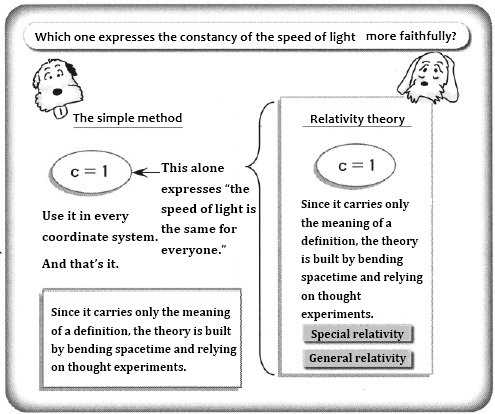
Yet if one focuses solely on expressing the principle faithfully, the mathematization should have been remarkably simple. For example, if we adopt the light‑second—the distance light travels in one second—as the unit, then we obtain
c = 1
This requires the condition that no coordinate transformation be applied to the speed of light. There is no simpler equation than this.
The “1” here means one light‑second. As you can see, it is merely the principle—concerning only the speed of light—written directly as an equation.
With the unadorned statement “the speed of light is 1,” light has a speed of one light‑second per second for every observer, regardless of their motion.
If the speed of light is independent of the observer’s motion, then the observer’s speed v should not need to be considered at all. When Einstein’s requirement for the behavior of light is expressed accurately in an equation, the observer’s speed v has no physical or mathematical meaning.
Therefore, including v in an equation meant to express the invariance of light speed is actually problematic. One might object:
“Relativity also sets the light speed to c, about 300,000 km/s.
If we simply call that value 1, then c=1 becomes the same equation.
Doesn’t that mean relativity’s mathematization is correct?”
Superficially they look identical, but the task here is to mathematize the principle of the invariance of light speed. Which one has already completed that task at this stage?
The earlier equation c=1 is already complete. Nothing more can be added or developed. Whether the speed of light is truly invariant for everyone must be left to physical experiment. It is complete without any further mathematical development. That is simply the fate of a thought experiment.
In contrast, relativity’s c=1 carries only the meaning of a symbolic definition, not a completed mathematization.As a result, the expression of the principle spans the entire, endlessly extended structure of relativity, beginning with the thought experiment.
The observer’s speed v—which no one had asked to include—was absorbed into relativity because the assumptions were not examined carefully at the mathematization stage, and a development that should have stopped simply failed to stop.
Had the earlier equation been used, the principle of the invariance of light speed would have held simply and without contradiction. No one can convincingly explain why a contradiction‑laden theory that bends spacetime itself is needed just to uphold the principle.
3.3. Incorporate the Principle of Relativity
Relativity begins with two principles. Even if the invariance of light speed is settled with c = 1, we must not forget the mathematization of the other one—the principle of relativity.
"According to Galileo’s principle of relativity,
“In any two frames moving uniformly relative to each other, all laws of motion must be equivalent.”
Different wording exists, but the meaning is the same.
Suppose we observe a physical phenomenon inside a rocket moving uniformly through space (frame A), and from this we derive a relation and complete a physical equation.
“This same relation must hold exactly in another rocket (frame B) moving uniformly as well.”
"The reason is that the principle of relativity states that
“Within a single frame, it is impossible to detect the motion of that frame.”
Thus, an observer in frame B is not allowed to determine the motion of B from observations made solely within B.
If the physical phenomena in frame B failed to match the equation, then an observer in B could detect the motion of the frame from internal observations alone. That would violate the principle, so we must assume that the same equation of motion holds in frame B.
Keeping this in mind, we proceed with mathematization. Relativity was constructed so that the form of the equations of motion does not change in any inertial frame.
If we resolve only the invariance of light speed with c = 1, the remaining principle of relativity forces the form of the equations to change. It is precisely because classical physics cannot achieve this invariance that the relativistic equations are accepted.
Constructing equations that remain invariant under coordinate transformations is no easy task. It requires advanced mathematical knowledge and, at times, genius‑level insight.

3.4. An Over‑Interpretation Built on Too Small a Premise
When things develop this way, mathematically inclined scholars tend to leap in and start exploring all sorts of possibilities. But this is one of relativity’s methods for diverting attention from the real trick.
When a difficult problem is posed, people’s curiosity is stirred and they want to solve it. They rush ahead, leaving behind the problems that actually needed to be settled first.
Before employing advanced mathematics, we should reconsider whether such work is even necessary.
The principle of relativity merely states that
“Among frames moving uniformly relative to each other, all laws of motion must be equivalent.”
Galileo never claimed that classical physics violated this principle. Altering an older theory without first examining whether revision is necessary is a dangerous act.
Yet classical physical equations are not invariant under coordinate transformations. How should we interpret this?
We focus on the term “equivalent”, which appears in various forms within the principle.
"Sometimes it is phrased as
“same form” or “equivalent,”
but the meaning is identical."
What, then, is the same? Naturally, the “laws of motion,” though they are also expressed as “equations of motion” or “fundamental laws.”
However, “fundamental laws” seems to have been used by Einstein to broaden the interpretation of the principle, so we set that aside here.
In any case, what we are dealing with is a “law,” and here that law is the Galilean transformation. In classical physics, the form of the Galilean transformation does not change when the frame changes. Only the numerical values used in the transformation change.
This is what “same form” means in the principle of relativity.
“So you’re saying we don’t mathematize the principle of relativity?”
Not at all.
“The mathematization is already complete.”
"More precisely:
“If we treat physical quantities numerically, the Galilean transformation is automatically incorporated.”
To evaluate physical quantities, we choose a standard and compare objects, times, and distances to it. The operations used in such comparisons are the same as those in the Galilean transformation.
Thus, once we convert physical quantities into numbers for evaluation, the Galilean transformation is inevitably incorporated, whether we intend it or not.
(This recognition is crucial for understanding relativity’s trick, so consider it carefully and judge for yourself.)
And really—do you think Galileo, who proposed the principle of relativity, would use a contradictory transformation?
He must have adopted it precisely because he clearly recognized that it contained no contradiction. Naturally so—he understood the meaning of the principle and used the transformation only within the range where no contradiction arises.
Einstein, however, pushed the idea of “equivalence” so far that he tried to make even the transformed value of c identical, and in doing so ended up creating new equations that bend spacetime.
3.5. The Secret of the Speed v
“The speed of light appears constant to everyone.”
From the conditions of the principle of invariant light speed, anyone would think this way.
“Since it has a fixed value in any frame, we can simply define the light speed as the constant c and develop the theory.”
Einstein and every scientist who supports relativity begin their theoretical considerations by defining the light speed as the constant c.
In symbolic equations, the choice of letters is fairly free as long as symbols do not overlap. Whether we use c or D for the light speed, the result is unaffected once numbers are substituted. Normally, any letter or symbol should be acceptable.
But is it really acceptable?
“Questioning even the choice of symbols only restricts mathematical freedom and is meaningless.”
A hundred mathematicians out of a hundred would likely agree.
But relativity is a special case. To confirm this, the best approach is to calm down and perform the thought experiment again.
So let us imagine Einstein has just now proposed the principle of invariant light speed.
“The speed of light is the same value c
for any observer moving at any speed v.”
Hearing this, you immediately attempt a thought experiment to understand the principle.
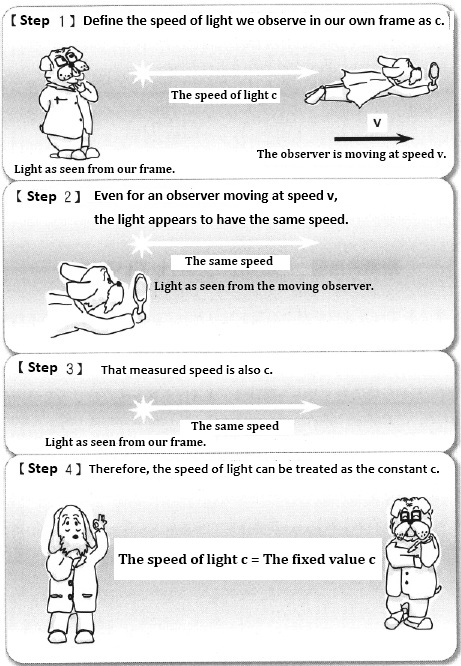
Let us proceed assuming your thought experiment contains no major differences from the usual one.
Hidden within this seemingly ordinary sequence of thought experiments is one of the greatest theoretical tricks of the 20th century—did you notice? It is a trick capable of deceiving everyone—from Einstein and physicists to mathematicians worldwide and even beginners reading textbooks.
Recall Einstein’s trick: while everyone watches the “jump,” their attention is diverted from the shifting background. The same trick is used in this thought experiment.
The “jump” this time is the adoption of the light speed c. As everyone shifts their viewpoint into the moving frame to observe light under the principle,
the observer is performing a coordinate transformation themselves.
In Step 2, one merely applies the principle of invariant light speed, and nothing feels unnatural—but this is the trap.
The phrases “for anyone” and “even for an observer moving at speed v” are preconditions for the principle. Without them, the principle cannot hold.
Just as young Einstein imagined flying with a mirror, everyone mentally leaves their original frame and instantly becomes an observer in the moving frame.
Only by shifting to a third‑person viewpoint and assuming the light speed is constant does the principle acquire meaning. A principle of speed transformation without assuming coordinate transformation is impossible.
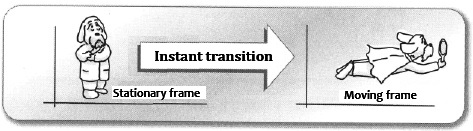
If this still feels unsatisfying, ask yourself:
“What is the reference for the observer’s speed v in relativity, and how was it computed?”
Most likely, you measure the moving frame’s speed using your own frame as the base frame. But from any frame other than the base frame, that moving frame does not have speed v.
Yet we still use v here because we implicitly treat the base frame as having speed 0 and compute
speed of moving frame = v−0,
the relative speed between frames.
And that method of computing speed is called
the Galilean transformation.
Einstein declared the Galilean transformation an approximation, unsuitable for obtaining exact results. Yet relativity is built upon a thought experiment that uses this very approximation—a rather strange situation.
This is not merely a matter of “approximations being imprecise.”
The real issue is that the Galilean transformation—used as the foundation of the thought experiment
is never recorded anywhere.
This omission will become a serious problem later on.
3.6. Where the Galilean Transformation Hides
The fact that the base frame used to observe the light speed C is computed through a Galilean transformation directly affects everything from Step 3 onward.
Without Step 2, neither the Galilean transformation nor the principle of invariant light speed would exist. In Step 2, the entire observational frame is transformed by the Galilean rule, yet the light speed alone is required to remain c.
When a segment in one frame is viewed from a moving frame, it changes because that is how our mathematical system works. This is unavoidable whenever we use mathematical coordinate transformations, regardless of physical interpretation.
Since the foundation is unquestionably the Galilean transformation, the light speed must also be dragged along by the frame. Something that has speed C in the base frame cannot remain C in the moving frame—mathematically, that is not allowed. With nothing special applied, it is first transformed into
C − v.
Because the rules of the mathematical system take precedence. Step 3 only becomes effective after this.
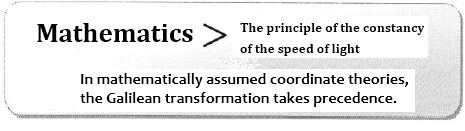
Had we used the special treatment c=1, the entire development would have ended cleanly with no further complications. The method chosen by the principle to nullify the Galilean transformation is simply
definition.
It merely defines the symbol c as the light speed, ignoring all prior steps and the Galilean transformation entirely. It simply discards the transformed value C−v from Step 2 and redefines it as c in Step 3.
Since C−v becomes c, Step 3 can be viewed as a function that converts the Galilean‑transformed light speed into c.
Let this function be f. Then
f ( C − v ) = c (Equation 3‑1)
holds.
Evaluating the function gives
f ( C − v ) = C − v + v = c (Equation 3‑2).
The expression inside the parentheses is the classical light speed C after coordinate transformation. The equation means
“adding the moving frame’s speed v to the transformed light speed”
— that is, simply
canceling the speed v.
The principle of invariant light speed seems difficult, but once opened, it merely cancels the frame’s speed v.
And it accomplishes this not through calculation or equations, but through the brute force of definition.
In doing so,
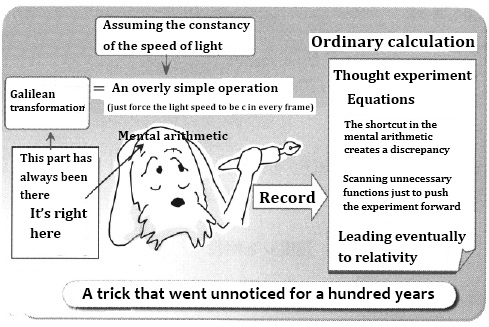
“the Galilean transformation and its cancellation are handled mentally, without being written down.”
Einstein did not have the habit of explicitly writing down the functions he used. Scientists, performing the same mental arithmetic, ended up accepting relativity.
Even as relativity was built and relativistic cosmology debated the origin of the universe, this transformation remained
abandoned in the minds
of those who accepted relativity.
Is a Speed That Looks the Same to Everyone
Really a Valid Standard?
“Light is special. No matter what motion the observer is in, it always appears the same. That’s why relativity is built by taking the speed of light as the universal standard.”
“If person A lives in an ordinary world, and person B lives in a strange world where lengths and times shrink to half, and both observe a rocket flying at 0.5 c,
how is relativity supposed to distinguish the difference between their worlds?
You can’t derive equations of motion using light as the standard when it looks the same to everyone.
There’s no frame‑specific data inside c at all.”

3.7. c is a Function
The transformation handled mentally was forgotten for a hundred years—but that is merely a problem of our awareness. Even when pointed out, people may dismiss it with, “I guess we did do that in our heads.”
But mathematics is far cooler and far stricter. Any step omitted and done mentally will inevitably hide somewhere and exert influence. Look again at Equation 3‑1:
f ( C − v ) = c (Equation 3‑1)
The left side is a function; the right side is c. Do you see what is happening here?
All the unconscious operations in the thought experiment—
the Galilean transformation and the cancellation of v are being compressed into the single symbol c.
If the c used in relativity is actually a function, relativity collapses immediately (for v≠0).
Many equations in relativity contain c. If those c’s are not constants but functions, every one of them must be recalculated. And before those recalculations are complete, any claim that “the theory matches experiment” becomes meaningless.
Moreover, if c alone fully expresses the principle of invariant light speed, then even after considering the principle of relativity, no further theoretical development is needed. In other words, a theory like relativity becomes unnecessary.
3.8. A Variable Becomes a Constant
In Step 4, c is defined as a constant. This means the principle of invariant light speed is making the mathematical demand that it be
“a constant for everyone.”
“For everyone” means “even after a coordinate transformation,” so the demand becomes:
it must remain constant under coordinate transformation.
In the mathematics we use, no “constant” remains the same value after a coordinate transformation. Such a number does not even exist as a concept. At best, a function f can cancel the transformation, but that is not a constant.
Because the function f contains the variable v, and its operation depends on v, the function inevitably behaves like a variable. Thus, following the principle forces c to have the nature of a variable. Treating a function as a constant amounts to declaring
“variable = constant.”
(in the usual mathematical system)
This undermines mathematics at its foundation; it is a kind of reset operation.
The moment c is forcibly defined as a constant, the mathematical system breaks. Continuing the development after that produces a mathematics unlike the one we use—relativity’s own special mathematics, where ordinary logic no longer applies.
In this system, a variable is a constant, and 1 is both 1 and not 1. Relativity is built on a mathematics that tolerates such contradictions. The more one treats it as ordinary mathematics without noticing the system has changed, the more contradictions accumulate.
Modern relativistic physics is built upon this special system. Unless we reconsider the idea of interpreting it using our usual mathematical concepts, physics will only fall into deeper confusion.